Installers: Here’s why 6mm² cable is the smart choice for installing EV chargers
In this article, Phill Brookes-Maddicks, a qualified electrician at Indra, draws on his hands-on experience to explain why it's best practice to using 6mm2 cable to install an Indra charger.
In this article, we break down why Indra recommends 6mm² cable and a 40A breaker when installing Indra’s 7.4 kW EV chargers, and how this best-practice approach reduces callouts, protects your reputation, and delivers more reliable installs for your customers.
As an installer, you know that the correct cabling and breaker sizing is critical for safety, reliability, and regulatory compliance. At Indra, we recommend using 6mm2 cable, a 40A breaker and appropriate conductor classes (Class 2 and Class 6/7) for our 7.4kW (32A) EV home chargers.
While choosing the right cable diameter is essential for voltage drop and thermal performance, the type of conductor inside the cable—its class—is also key to ease of install and long-term reliability.
At a glance: why 6mm² and 40A matter
Before we dive into the details, here’s a quick overview of why our 6mm²/40A recommendation matters—and how it benefits you and your customers:
Lower voltage drop
Better thermal performance and current-carrying capacity
Compliance and reduced liability
Built-in futureproofing
Using the right cable for installation is key
Why we recommend 6mm2 cable and 40A breakers
1. Lower voltage drop
Lower voltage drop means the EV receives its full charging power and keeps the cable running cooler. Because EV home chargers often require long cable runs from the consumer unit to the driveway or garage, using 6mm² cable helps keep voltage drop within the 4% tolerance stated in the EV Charging Equipment Installation Code of Practice Edition 5, Section 5.3.5.3. It also helps keep the voltage at the charger within DNO tolerances (+10% / –6%), reducing the risk of nuisance O_PEN fault tripping events. Many installers aim to stay well below the commonly used 3% voltage drop target for final circuits.
Indra recommends using a 40A breaker with the 6mm2 cabling
2. Thermal robustness and current-carrying capacity
EV chargers run at a high, continuous load for long periods, which puts sustained thermal stress on the circuit. Using 6mm² cable reduces thermal build up in the switchgear, reducing the risk of nuisance tripping. Using a Class 2 or Class 6/7, 6mm2 cable has the added benefit of reducing physical stress on the electrical connections due to thermal expansion, compared to Class 1.
A 40A breaker is recommended because running a 32A circuit breaker for prolonged periods at its maximum rating can cause it to thermally trip.
3. Compliance and liability
UK wiring regulations (BS 7671:2018) do not mandate a specific cable size for 32A EV circuits, but it does require the installation to be designed considering:
Using 6mm2 helps satisfy these factors under almost all real-world installation conditions, reducing risk and liability for the installer.
An often-overlooked regulation that has considerable influence on the selection of cable type and size is Regulation 512.1.5 (compatibility) of BS7671:2018 Amendment 2. In short, it says that you must assume the maximum operating temperature of switchgear is 70⁰C unless the switchgear manufacturer states otherwise. Meaning that you cannot take advantage of the increased current-carrying capacity of a 90⁰C cable because the switchgear is only rated to 70⁰C.
This means that the maximum current rating of cables must be taken from tables 4D1-4D5, and no 4mm cable on these tables is rated at 40A or above.
4. Futureproofing
Installing 6mm² cable and 40A breaker first time allows for:
upgrading to a faster charger
load balancing systems
bidirectional charging (V2H/V2G)
without needing a costly rewire in the future.
It will also position installers as a forward-thinking professional who delivers long-term value to customers.
Even if the customer keeps a 7.4 kW charger, future features may benefit from the additional headroom.
Getting the right cabling and breaker on first install futureproofs the charger for the customer
When 4mm2 is still OK
The only conditions under which 4mm² cable can be used are:
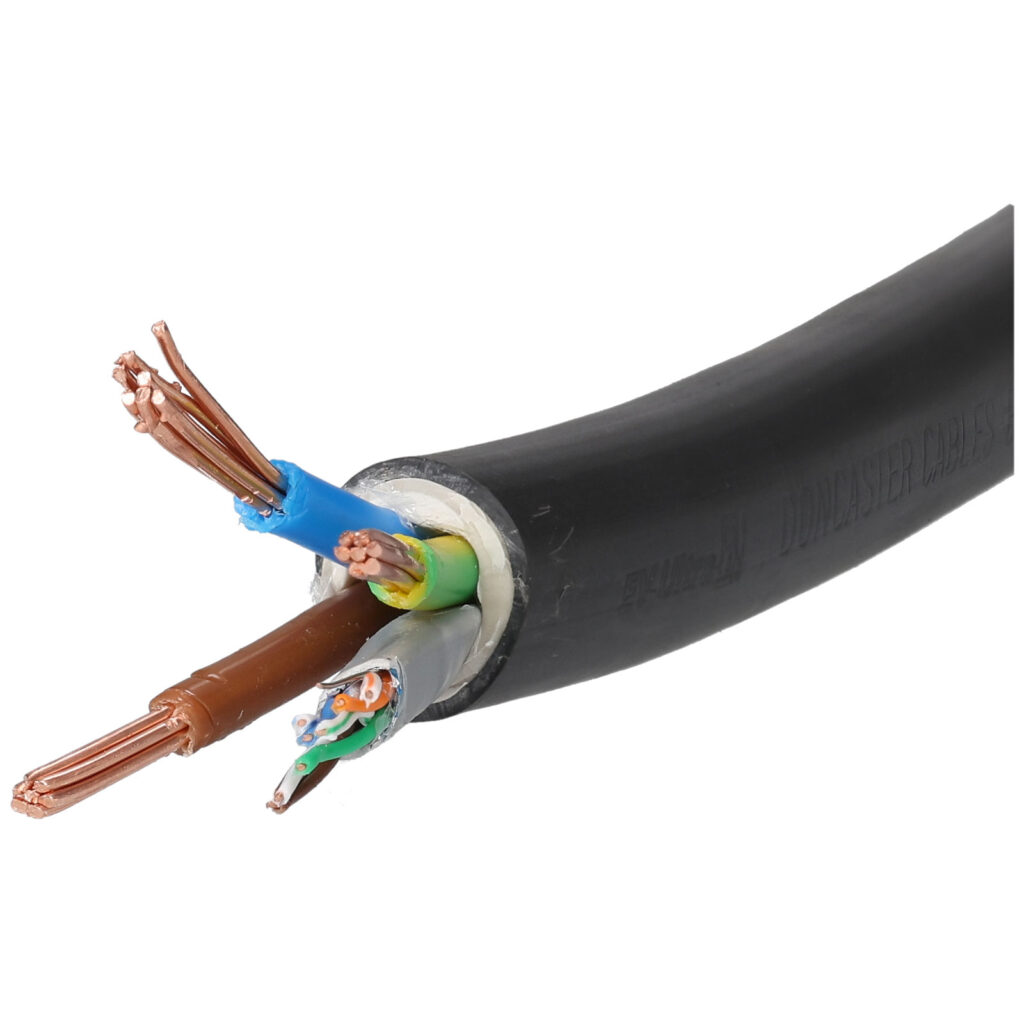
It is Doncaster EV Ultra® 4mm² cable, which has independent testing showing it can safely carry 45A continuously. (However, this deviation from BS7671 would need to be identified on the installation certificate) OR
The breaker is reduced to 32A, limiting the charger’s maximum current to ~30A
Because Indra recommends a 40A breaker, 4mm² cable is generally not suitable.
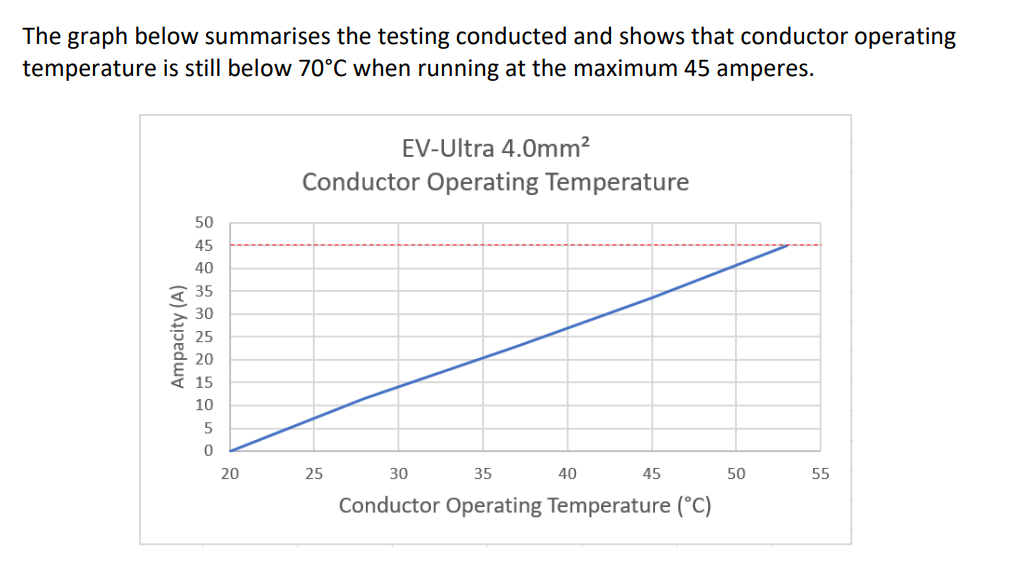
At present, Doncaster EV Ultra® is the only cable with verified data demonstrating it meets our thermal and current-carrying requirements (operating below 55°C at 45A continuously. For more information, refer to the EV-Ultra® Indra Technical Annex at the end of the article.
We are not endorsing the brand—it is cited purely as the current example that satisfies our standards.
Following best practice guidelines can prevent callouts and increase customer satisfaction
Installer benefits of following best practice
Using Indra’s best practice recommendations in this matter offers installers several benefits:
If attending an already installed EV home charger, where 4mm2 cable has been used inappropriately, we recommend that the original installer be contacted to discuss corrective action.
Using Indra’s recommended cable sizing also protects installers, as any future warranty investigation will assess whether the installation met our best practice guidelines.
At a glance: optimal installation
- 6mm2 cable (Class 2) - 40A breaker - ≤4% voltage drop target of EVs
EV-Ultra® Indra Technical Annex
Electrical Properties of EV-Ultra® 3x4.0mm² based on an ambient temperature of 30°C and conductor operating temperature of 70°C are detailed below.
Maximum current carrying capacity = 45 amperes (single phase)
Voltage drop = 12 mV/A/m
If the cable cannot be changed, reducing the breaker to 32A is possible. However, this should come with a drop in maximum charging current to ~30A, or the breaker may trip due to continuous near-limit current, resulting in repeated callouts.
When using 4 mm², installers must still verify that the appropriate cable calculations are within allowable limits.
About the author: Phill joined Indra in March 2022 as an Installer and Trainer after working for the Royal Air Force as an Avionics Technician for 12 years, and training as an electrician post-RAF. He is now the Sustaining Team Lead in Training and Installation.
Share this
Related articles
Celebrating International Women in Engineering Day: Meet Meghana and Talitha
A Surge Protection Device, or SPD, helps reduce the risk of damage to your EV charger from sudden voltage spikes caused by lightning activity, electricity network faults or sudden changes in your home’s power supply.
Why add it?
✓ Helps reduce the risk of surge-related charger damage
✓ Adds protection for sensitive electrical equipment in your home
✓ Recommended by Indra for peace of mind
✓ Supports a standards-aligned installation
UK wiring regulations require surge protection to be considered as part of an electrical installation. In many cases, it should be included unless the property owner confirms they do not want it and accepts the risk.
If you choose not to add surge protection, it may be worth checking any relevant warranty or home insurance wording.
Key takeaway: an SPD is a small addition that can help protect your charger and reduce the risk of unexpected costs.
Around 70% of our customers qualify for a standard installation. To find out if you do, we’ll send you a quick guided survey straight to your phone by SMS.
The survey is simple to complete and walks you through everything step by step—no electrical knowledge needed. Once you’ve finished, we’ll confirm whether your installation is standard or if any extra work is required. If additional work is needed, we’ll explain what’s involved and share any costs upfront. Below is what’s included in our standard installation.
Installation of the charge point on a brick or plaster wall, or other suitable permanent structure
Surface-mounted external cable clipped direct to the wall surface, no more than 1.8m above the ground
The fitting and testing of electrical connections as required
Make good all drilling and penetrations to walls
Ensure connectivity for Smart functionality on the unit
Customer demonstration of unit, controls and mobile application
Transport of unit from storage to customer property along with all required installation materials
Up to 10 metres of cable, run and neatly clipped to the wall between the electricity supply meter or distribution board and the charging point
Compliant to latest wiring regulations
Up to 3 metres of plastic conduit/trunking to conceal interior wiring
An electrical certificate will be issued to the Customer within 1 week of the installation following an internal checking and auditing process
What can increase the cost of your EV chargepoint installation?
There are a number of factors, but here are a few examples that can increase the cost of your installation:
Extra cabling - if more cabling over the 10 metres already included is needed then this will cost extra.
Water or gas bonding - Your house should already have this but if not, we are legally obliged to ensure a house has gas and water bonding before we do any work, in our case, install your EV charger. Bonding is a connection of metallic parts with a protective bonding conductor. Without bonding, in a fault condition, metal appliances connected to the gas or water pipes could cause the associated pipework to become live. If you then touch them, you could receive a potentially fatal electric shock.
Extra labour - for more complex installations or for jobs that will simply take longer (above the three hours included).
No Obligation Home Survey
Around 7 in 10 installations are standard so if yours is one, the price you see on the website will be the price you pay.
To check whether you qualify for a standard installation we ask you to do a short online home survey. This is sent to your mobile via text. Once completed you will be contacted by an installer to confirm whether or not yours qualifies as a standard installation and to provide you with your no-obligation quote.
If there are any additional costs due to your home set up, we will be clear about the costs. You can decide whether or not to go ahead.
Off-street parking
Indra chargers need off-street parking so that the charger can be attached to your home and the charger cable doesn’t cross a public pavement and become a trip hazard.
By off-street parking, we mean things like a garage, or a driveway that’s part of your property.
Works With Solar
If you have solar panels already installed at home, you can use the power of the sun to charge your EV for free.
The charger will automatically use any surplus solar power that’s not being used by your home, and as long as your EV is plugged in (and the sun is shining) you can start charging from your panels.
Choosing between tethered and untethered chargers
You have two options to choose from with EV chargers: tethered and untethered.
Tethered means the charger has the charging lead permanently attached to it, which makes it more convenient. You can just plug in your EV to start charging. Indra charging leads come in a variety of lengths and wrap neatly around the charger when not in use. Choosing a tethered charger means that, unlike with an untethered charger, you're not having to store what can become a dirty cable in the boot of your car. Our research suggests that many first-time buyers choose an untethered charger but would, with the benefit of hindsight, choose a tethered option.
Untethered means you’ll need a separate charge lead which you’ll plug into both the charging unit and the vehicle when you need to charge. This option means you can choose the length of cable you need, or even use a charging cable you might already own. Untethered chargers are great if you want a minimalist-looking charger with sleek lines.
What's Next?
Around 7 in 10 homes are a standard installation. However, to ensure that you are not hit by any unexpected extra costs, we ask you to do a short online home survey. This is sent to your mobile via text. Once completed you will be contacted by an installer to confirm whether or not yours qualifies as a standard installation and to provide you with your no- obligation quote.
What is a MAC address and how do I find it
A Mac address is a unique ID which identifies your particular EV charger. The MAC address looks like a series of numbers and letters (e.g., 00:1A:2B:3C:4D:5E). You can find your Mac address in 2 ways, either using the Indra App or by looking on the EV charger itself.
Using the Indra App
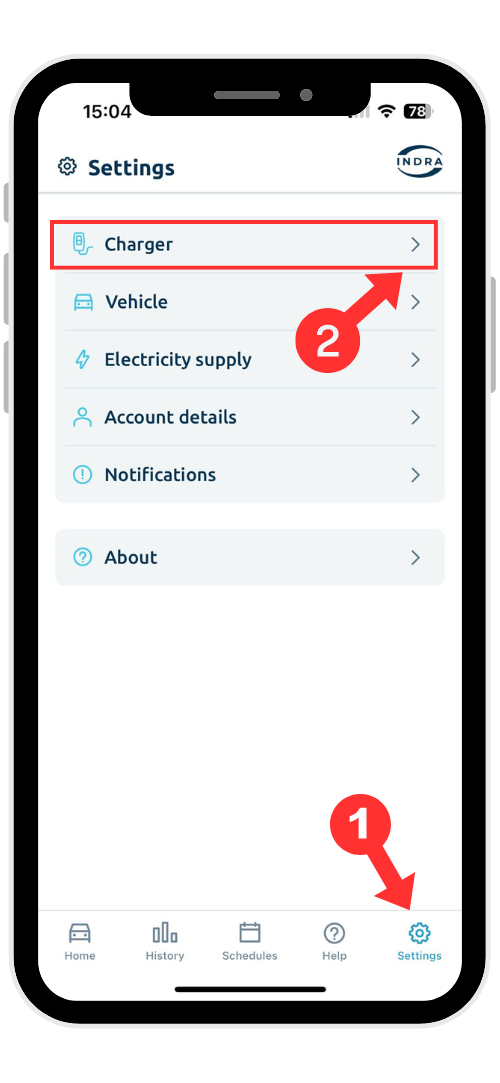
Select 'Settings' from the bottom menu - see below
Select 'Charger' from the list - see below
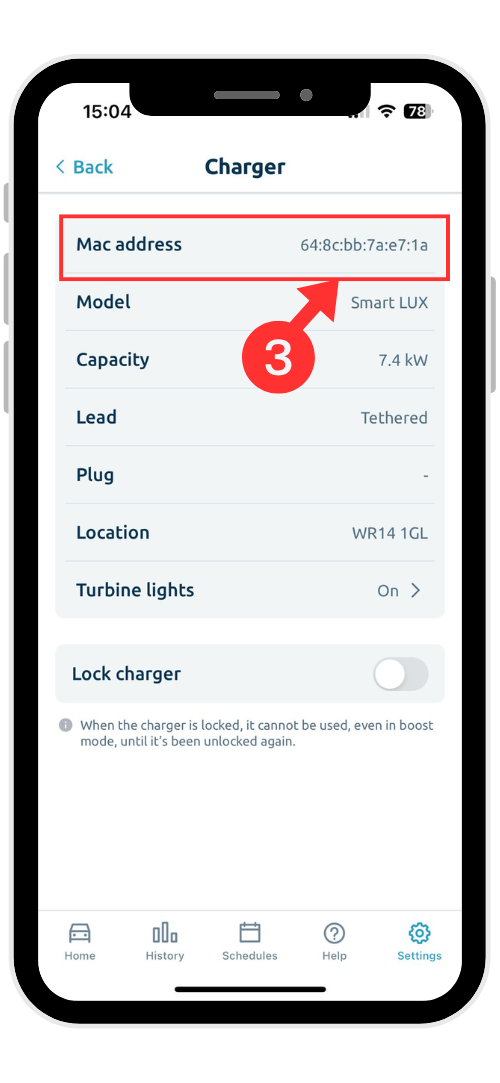
3. You can then see the Mac address at the top of the Charger page - see below.
On the charger
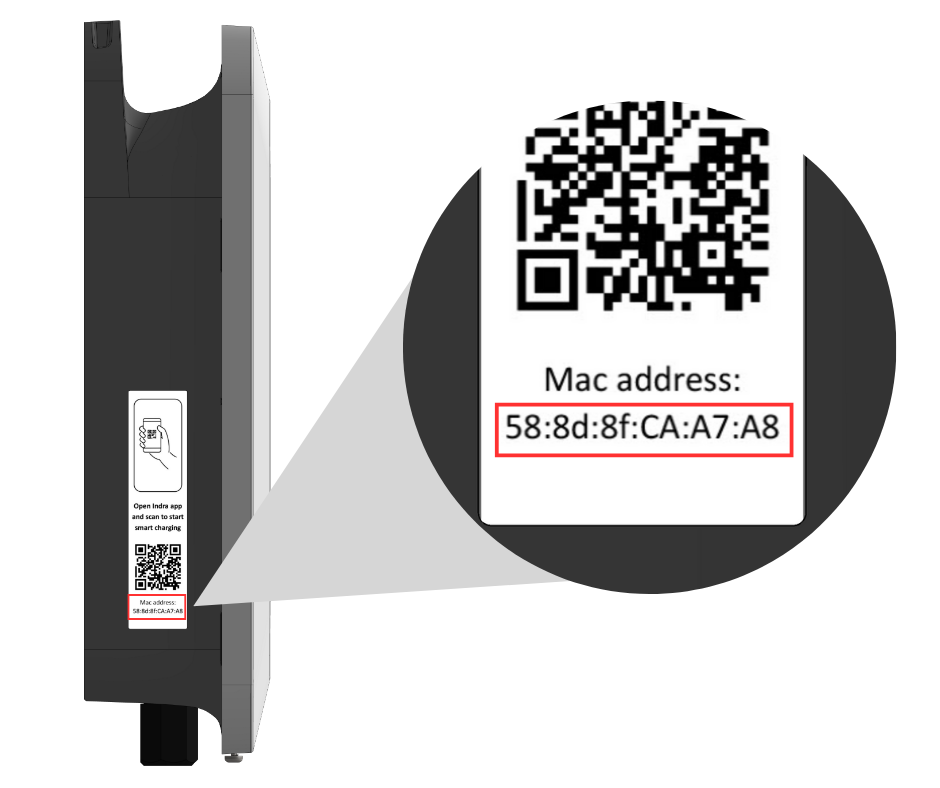
You can find the MAC address on the sticker located on the side of your EV charger. Please refer to the example shown below.
LED Lights on Your Charger
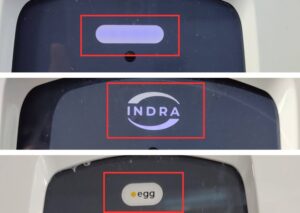
Knowing what the primary LED light on an Indra charger is doing really helps us to resolve your issue. Depending on your model of charger, the primary LED will be one of the 3 versions below.
Tell us what colour it is and whether its solid or flashing.
Purple-Solid
If your charger LED light stays purple for more than 30 seconds, there could be a problem. Please submit a ticket and we'll help sort it.
Purple - Flashing
Your charge point is offline. Before submitting a ticket please refer to our troubleshooting guide. Your charger will continue to follow the existing charging schedule created in the Indra app.
Red - solid
There is a hardware fault or fault with the wiring. Please submit a ticket and we'll get right on it.
Red - flashing
This is a temporary fault, please reboot the charger to clear the red LED. If it persists, please submit a ticket,
Blue & Orange - Flashing
Your charger is in Bluetooth pairing mode. Before you submit a ticket, wait for 15 mins as the flashing should stop. If problems persist, please submit a ticket.
Orange - flashing
Your unit is in WPS pairing mode. Before you submit a ticket, please wait 2 mins for the LED to return to a white colour. If the problem persists, please submit a ticket.
Green - Solid
A charging schedule is active. Relax, there is no fault with the charger and you do not need to submit a ticket.
Pay in 3 with Klarna
Indra has partnered with Klarna, a leading payment provider, to give you more flexibility in your purchase experience.
Why use Klarna
No interest
Easy automatic payments
Simple, safe and smooth
Quick facts
What it is: Split your total into 3 equal payments, with no interest if paid on time.
When payments are taken: 1st payment at order confirmation, then 2nd at ~30 days and 3rd at ~60 days.
Where to manage payments: the Klarna app or klarna.com.
How it works (step-by-step)
Add items to your basket and go to checkout.
Choose Klarna → Pay in 3 as the payment method.
Enter a few details (name, billing address, email, mobile) and a debit or credit card to be used for repayments.
If approved, your order is confirmed and dispatched as normal. Klarna will automatically take the first instalment immediately and the remaining two instalments about 30 and 60 days after the order.
Klarna checklist - what you need
Be 18+.
A valid mobile number and email address.
Your billing and delivery address (best if they match).
A UK residential address (if buying from UK store).
A debit or credit card that will be valid for the next 60 days.
Make sure you have enough funds on your card for the first payment when you place the order.
Eligibility & approval
Klarna’s offer is subject to a quick assessment of the information you provide. Approval depends on factors such as order value, your details, order history and item availability. Being accepted one time does not guarantee approval for every order. If you are not offered Pay in 3 this time, you can still try again on a future order.
Does Klarna do a credit check?
Klarna may perform a soft (unrecorded) credit check for Pay in 3 which does not affect your credit score.
Missed payments — what happens
If a scheduled payment cannot be collected, Klarna will try again and will notify you. Continued missed payments can lead to reminders, fees, or collection actions and could affect your ability to use Klarna in the future. For full detail on late payments and fees, refer to Klarna’s terms and the Klarna app.
Returns, cancellations & refunds
If you cancel or return your order and we (the store) confirm the refund, Klarna will cancel any future scheduled payments and refund amounts already collected where applicable.
For partial returns Klarna will update your payment schedule and statement. For full returns any collected payments will be refunded.
Always keep your proof of return and check the Klarna app for updated payment information.
Can I pay earlier?
Yes — you can pay off your remaining balance early through the Klarna app or by logging into your Klarna account online.
What information is shared with Klarna?
We share order and contact details with Klarna so they can assess and manage the payment plan. Card processing and payment security are handled by Klarna — we don’t receive or store your card details for the instalments. Your data is handled according to applicable data-protection laws and Klarna’s privacy policy.
Need help or have questions?
Check the Klarna app or klarna.com for your payment schedule, confirmations and FAQs.
For Klarna-specific queries (approval reasons, missed payment notices, refunds handled by Klarna) use the Klarna app or Klarna support.
Legal & responsible borrowing
Klarna Pay in 3 is a credit product. Please only use it if you can afford the repayments on time. For the full terms and conditions please see Klarna’s Pay in 3 terms.
Indra is not a lender and acts only as an introducer. The credit product is provided by Klarna Bank AB (publ). Credit is only available to permanent UK residents aged 18 and over, depending on their status. Terms and conditions apply. Please note that Pay in 30 days and Pay in 3 instalments are not regulated by the FCA.
Pay with RVVUP DivideBuy
Lorem ipsum dolor sit amet tellus sodales viverra dolore a hac praesent. Eu posuere auctor dictum quisque curabitur justo blandit labore malesuada pretium suspendisse gravida. Bibendum urna quis convallis vestibulum neque dapibus cras condimentum. Maecenas blandit magna bibendum volutpat aenean eleifend turpis dictumst. Nibh convallis feugiat ut platea molestie leo quam dolore hendrerit rhoncus est diam eiusmod.
What if my installation isn’t covered under the standard pricing?
If additional work is required, we’ll explain it clearly and transparently. We’ll provide a detailed quotation explaining what is involved and why. You’ll be able to review this quote and decide if you’re happy to proceed with the plan and the price quoted. If you are we will progress your order. However, if you do not wish to proceed, we will issue a refund.
What might cause my installation to be non-standard?
Examples of some non-standard situations include:
The electricity supply or distribution board is located more than 10 metres from where you’d like the charger installed and requires a greater length of cabling
Your charger needs to be installed on a detached garage, carport or post mount requiring a longer or more complicated installation job, which will take more than the included three hours of labour
The cable route involves going through complex structures, such as loft spaces or under floors, taking longer than the included time allocation
You require an upgrade to your main consumer unit, earthing or bonding arrangements. Bonding for gas and water is something we are legally required to ensure a house is fitted with. Without proper bonding, metal appliances or gas and water pipes can become live, creating life-threatening situations.