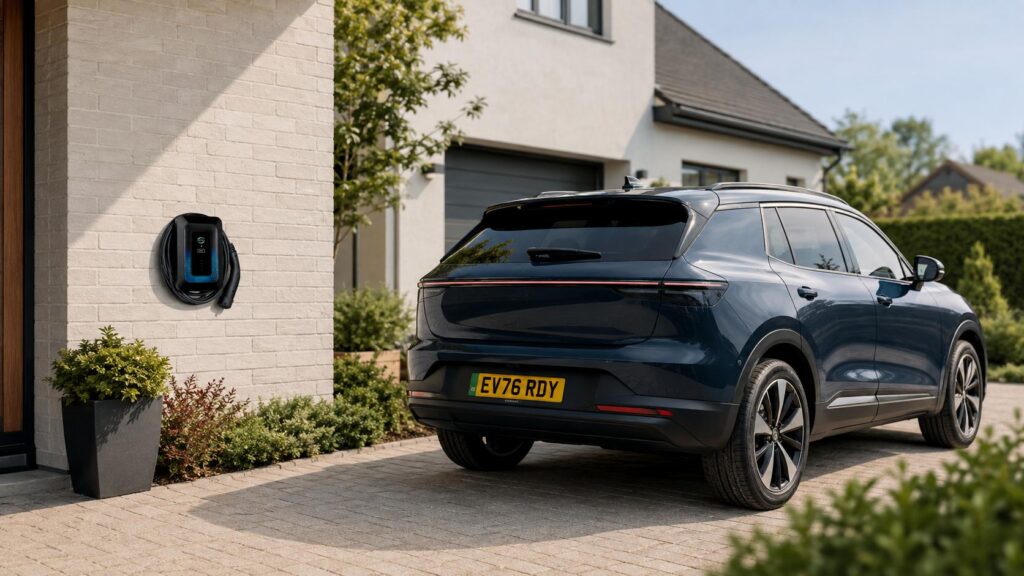
Ten things first-time EV buyers should check when choosing a home charger—from tariff compatibility and solar charging to installation and cable choice.
September 2026 will see the arrival of the new ‘76’ registration plate. Around 300,000 new cars could be registered during the month, including approximately 80,000 fully electric vehicles.[1] For many drivers, that will mean choosing an EV—and a home charger—for the first time.
Choosing the car is likely to involve hours of comparing range, performance, equipment and finance. The charger may receive much less attention, even though it could remain on your wall through several changes of vehicle and influence how conveniently and cheaply you charge every day.
Do not necessarily expect the vehicle handover to answer all your questions. EVA England’s 2025 Driver Survey found that, while 61% rated their EV handover as good or excellent, one in four described it as only fair or poor. Some respondents specifically highlighted gaps in dealership knowledge about EV charging.[2]

That does not mean every dealership lacks expertise. It does mean first-time buyers should investigate home charging for themselves—and preferably start when they order the car. Surveys, quotations, additional electrical work and any necessary Distribution Network Operator approval can all add time to the process.
Almost one in three UK households—around nine million—does not have access to a driveway or dedicated off-street parking.[3] This does not rule out owning an EV, but it means you should establish where and how you will charge before choosing the car.
Cross-pavement cable channels are available in some areas, but permission depends on local council policy and remains far from universal. For many drivers, the most realistic solution will be near-to-home charging through lamp-post or residential chargers, council car parks, workplace facilities or a private charger shared by somebody nearby.
Use Zapmap to investigate nearby public charging and ask your council about its current cross-pavement and on-street charging policies.
For a more detailed look at the alternatives, read our guide to five smart charging solutions for EV drivers without off-street parking.
If you have somewhere suitable to install a home charger, these are the ten questions to ask before choosing one.
It may be tempting to postpone buying a charger and use the portable three-pin cable supplied with some EVs. These are often called “granny chargers”.
A three-pin cable can be useful for occasional or emergency charging, but it is not usually the best long-term solution. It typically supplies around 2.3kW, compared with approximately 7.4kW from a dedicated home charger. Depending on the vehicle, eight hours of charging could add roughly 50–65 miles of range using a three-pin cable, compared with around 200–240 miles from a dedicated charger.

A dedicated home charger is designed specifically for sustained vehicle charging. It can also provide features that a three-pin cable normally cannot, including smart-tariff integration, surplus-solar charging and household load management.
If you intend to charge regularly through a three-pin socket, have the socket and its wiring assessed by a qualified electrician. Avoid using an extension lead, and do not assume an ordinary socket is suitable for sustained EV charging simply because the plug fits.
For a fuller explanation, read our guide: Are three-pin chargers for EVs safe? The pros and cons.
The charger recommended by your dealership may be a perfectly good option—but do not assume it has been selected after an objective comparison of the market.
Competition and Markets Authority research found that dealerships can have “preferred partner” arrangements with particular chargepoint providers. These arrangements may include referral fees or incentives when a recommendation results in a sale. The CMA warned that this can prevent consumers from being fully informed about the choices available.[4]
That does not mean you should automatically reject the dealer’s offer. If the charger is included free with the car or offered at a substantial discount, it could represent excellent value. However, you should still check that it suits your property, electricity tariff and everyday charging needs. A charger could remain on your wall through several changes of car, so the best choice for the dealership—or even for your new EV—may not be the best long-term choice for you.
Some EV tariffs provide cheaper electricity during fixed overnight hours. More advanced smart EV tariffs can communicate with a compatible charger or vehicle and automatically schedule charging when electricity is cheaper or demand on the grid is lower.
You plug in as usual, tell the app when you need the car and the technology manages the timing.
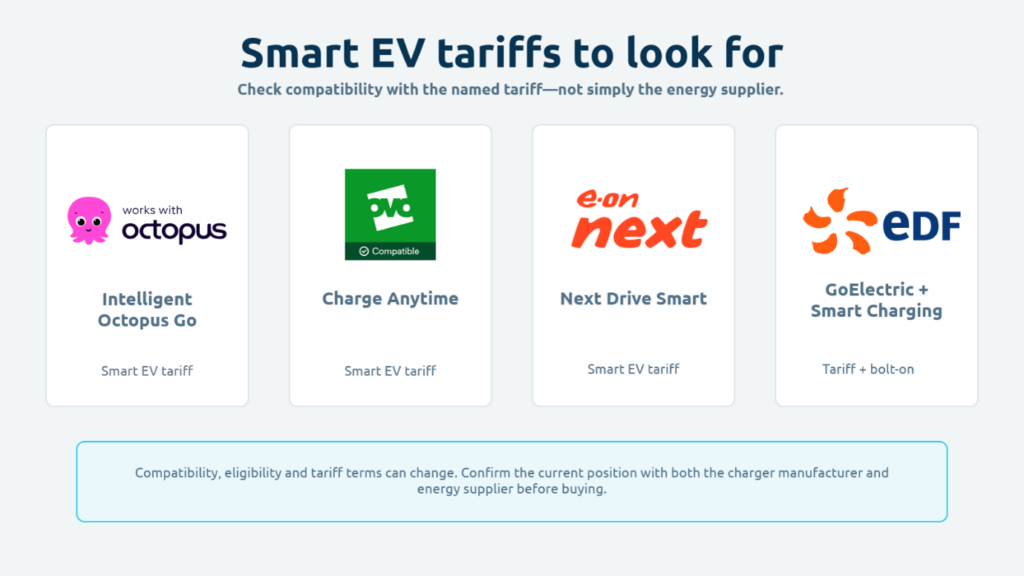
The potential difference in cost is substantial. Intelligent Octopus Go currently offers smart charging at 8p/kWh, while the average capped standard-variable electricity rate for July to September 2026 is 26.11p/kWh.[5] That makes the smart-charging rate approximately 69% lower, although tariffs, eligibility and actual savings vary. The table below provides a summary of the UK's main EV tariffs.
However, a charger being advertised as “smart” does not mean it works with every smart EV tariff. Compatibility may operate through the charger or depend on owning an eligible car.
Table 1: Selected UK smart EV tariffs
Indra chargers support leading options including Intelligent Octopus Go, OVO Charge Anytime, E.ON Next Drive Smart and EDF’s Smart Charging bolt-on. Compatibility can change, so confirm the current position before buying.
Also check whether scheduled charging remains available as a fallback and whether any integration requires an additional subscription.
A solar-compatible charger can detect when your home is generating more electricity than it is using and divert that surplus into your car.
This normally requires an energy sensor, often called a CT clamp, to monitor electricity flowing between the home and the grid. The charger can then adjust its output as solar generation rises or falls.
Using surplus solar electricity to charge your EV can reduce the amount of electricity you need to buy from the grid, although it may mean giving up the payment you could have received by exporting that energy. The saving is therefore the difference between the price of importing electricity and the export payment you forgo.
In many cases, using surplus solar to charge the car will still be more valuable than exporting it—particularly when grid electricity prices are high.
Indra chargers are solar compatible out of the box, with the hardware required to enable surplus-solar charging included as standard.
A tethered charger has its cable permanently attached. An untethered charger has a socket, requiring you to connect a separate cable whenever you charge.
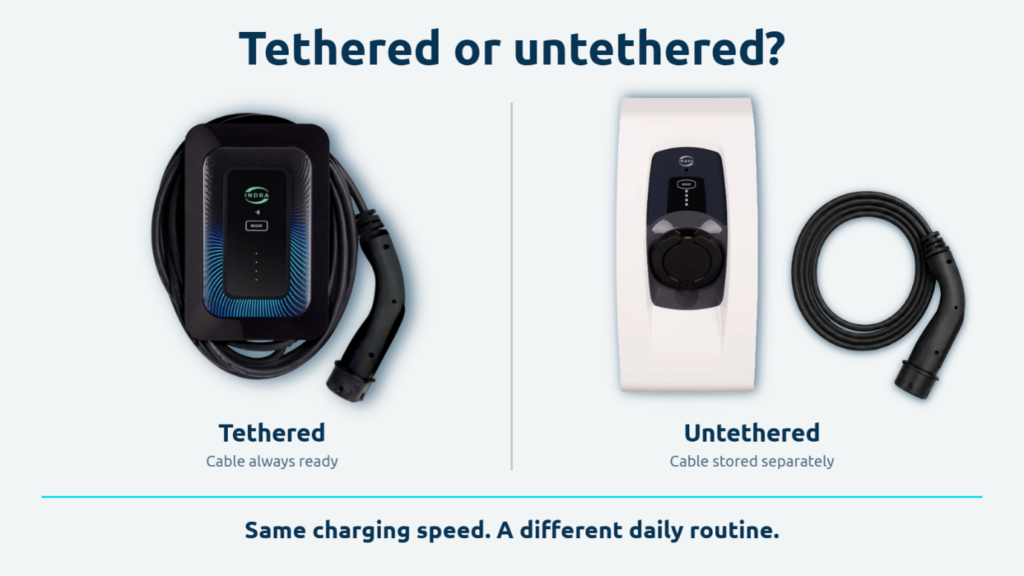
Both can provide the same charging performance. The difference is mainly one of convenience, appearance and total cost.
An untethered model may have a lower headline price, but look at what is included. If the vehicle does not come with a suitable Type 2 cable, you will need to buy one. Even if a cable is supplied, you may prefer to leave it in the boot for charging away from home rather than repeatedly removing and storing it.
A tethered charger makes the daily routine simpler: unwind the cable, plug it in and return it to the charger afterwards. With an untethered model, the cable must be connected at both ends and stored when charging is finished. That can become less appealing when the cable is wet or dirty.
Untethered chargers can look tidier when not in use, while a separate cable is easier to replace. Neither choice is automatically right for everyone.
A home charger draws a significant amount of electricity. If the car is charging while an electric shower, oven, heat pump or other high-demand appliance is operating, the combined demand could approach the limit of the property’s electricity supply.
Dynamic load management helps prevent this. It monitors how much electricity the home is using and automatically reduces the charger’s output when demand is high. When other appliances are switched off and capacity becomes available again, the charging rate increases.
This allows the car to charge safely within the available supply and, in some cases, may avoid the cost and disruption of an unnecessary supply upgrade.
Almost every new domestic charger is described as smart, but the quality and usefulness of its controls can vary.
A home charger should continue to provide basic charging if its app or internet connection is unavailable. However, a good app should make everyday tasks straightforward: starting or stopping a charge, creating a schedule, checking charging status and seeing how much electricity the car has used.
Useful energy information can also help you understand whether the charger is operating at the expected times and how changes to your tariff or charging routine affect costs.
In theory, a suitably qualified electrician can install an EV charger. In practice, chargepoints remain a relatively specialised area of electrical work.
An experienced installer should understand supply capacity, earthing, cable routing, dynamic load management, solar monitoring, app commissioning and the relevant Distribution Network Operator requirements.
Correct commissioning matters just as much as mounting and connecting the charger. A unit may supply power even though its smart-tariff integration, solar charging or load-management settings have not been configured correctly.
A home charger is not simply a box containing electrical hardware. Its app, internet connection and tariff integrations may remain important throughout its working life.
That makes ongoing support from both the manufacturer and installer worth considering. If the charger stops connecting, you replace your broadband router or a smart tariff changes its technical requirements, you need to know where help will come from.
Separate warranties may apply to the charger and the installation, so do not assume that one automatically covers the other.
Indra home chargers come with a three-year product warranty. Where installation is arranged through Indra, the installer also provides a one-year workmanship guarantee.
Charging speed often looms large for first-time buyers. In research conducted by Indra among people considering their first EV and home charger, it was the most important charger consideration identified. Although the sample was relatively small, the finding is understandable: it is natural to assume that the charger with the largest kilowatt figure must be the better choice.
In practice, around 7kW or 7.4kW is the standard power rating for a UK home charger. Most homes have a single-phase electricity supply, and Zapmap explains that home chargers generally support power levels of up to 7.4kW for this reason.[6]
A 7.4kW charger can typically add around 25–30 miles of range for every hour connected—usually more than enough to replace a day’s driving overnight.
Chargers offering 11kW or 22kW are available, but they normally require a three-phase electricity supply. Your car must also be capable of accepting the higher AC charging rate. Installing a 22kW charger will not make a vehicle with a 7kW onboard AC limit charge any faster.
Do not confuse the car’s public rapid-charging figure with its home-charging speed either. A vehicle advertised as capable of charging at 150kW will only achieve that when connected to a suitable public DC rapid charger—not a domestic AC charger.
For most households, features such as smart-tariff compatibility, solar charging, cable convenience, reliability and ongoing support will make a more meaningful difference than the maximum charging speed printed on the box.
Your first EV introduces a different way of refuelling: instead of making a special trip to a filling station, you can start most mornings with the energy you need.
But achieving that convenience requires a little preparation. Do not leave the home charger until the car is about to arrive or assume that every smart charger offers the same functions.
Choose a charger that suits your property, electricity tariff and everyday routine—not simply your current car. Installed and configured properly, it could make charging simpler and more economical through several years and several different EVs.
Indra has been designing and manufacturing intelligent home-charging technology in the UK for more than a decade. The Indra Smart LUX and Smart PRO combine 7.4kW home charging with app control, dynamic load management, solar compatibility and support for leading smart EV tariffs.
[1] Indra estimate based on SMMT data. The SMMT’s April 2026 outlook forecast 2.093 million UK new-car registrations during 2026, with a forecast BEV share of 26.8%. The SMMT has previously stated that September typically accounts for around one in seven annual registrations. Applying those proportions gives approximately 299,000 new cars and 80,000 BEVs. These are Indra calculations, not SMMT monthly forecasts. SMMT 2026 market outlook.
[2] EVA England 2025 annual driver survey.
[3] Zapmap, Home and community EV charging statistics. Field Dynamics analysis found that 32.8% of UK households—around nine million—did not have access to a driveway or dedicated parking space close to their home. View the statistics.
[4] Competition and Markets Authority, Electric Vehicle Charging Market Study: Final Report – Appendices, Appendix C, paragraphs 20–23, pp. C8–C9, July 2021.
[5] Intelligent Octopus Go rate checked August 2026. Octopus Energy and Ofgem electricity price-cap rates. Rates, eligibility and savings vary.
[6] Zapmap, The complete UK guide to EV charger connector types: “Home chargers typically have Type 2 inlets…and support power levels up to 7.4kW as most homes have one phase power.” https://www.zapmap.com/ev-guides/connector-types