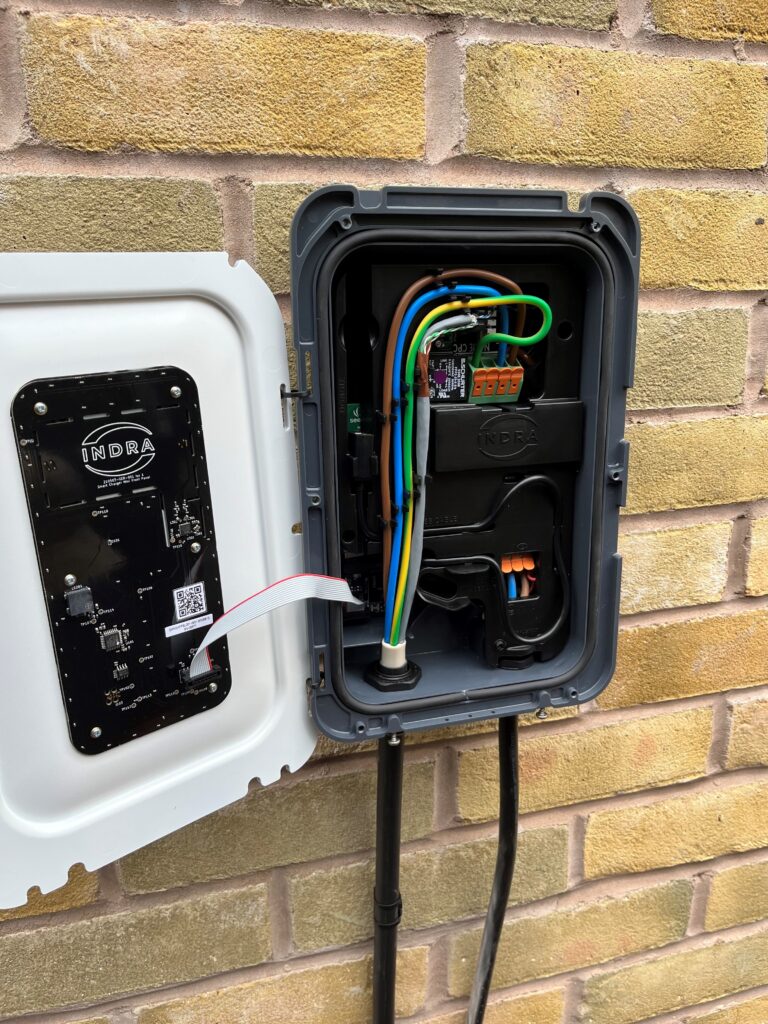
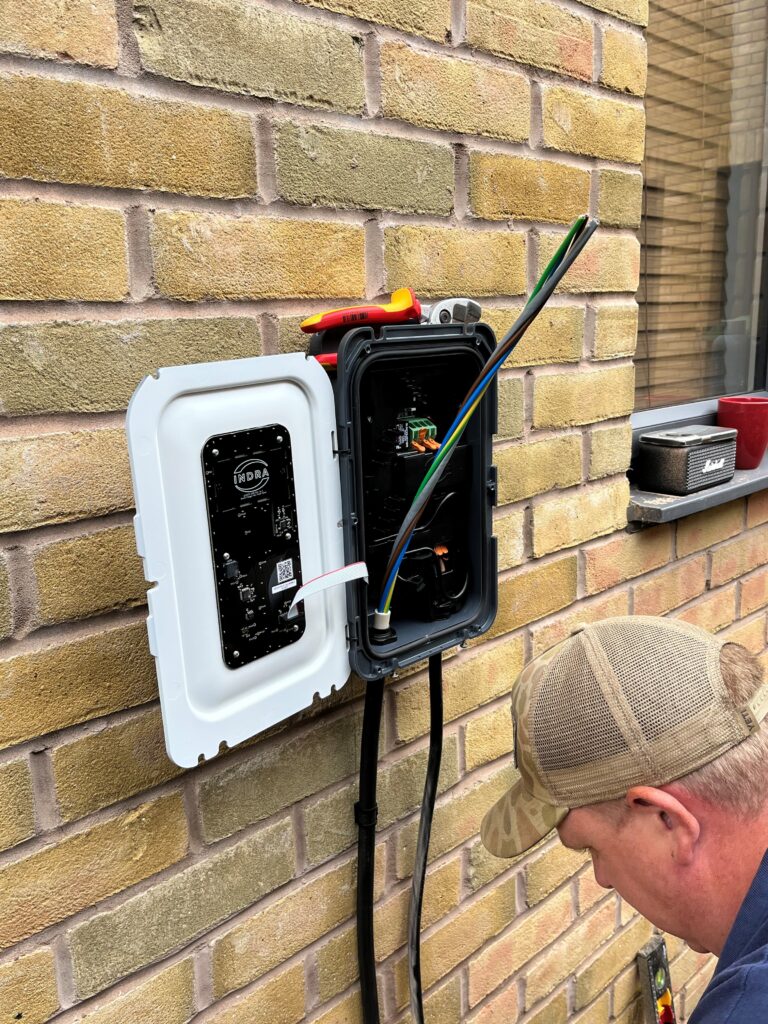
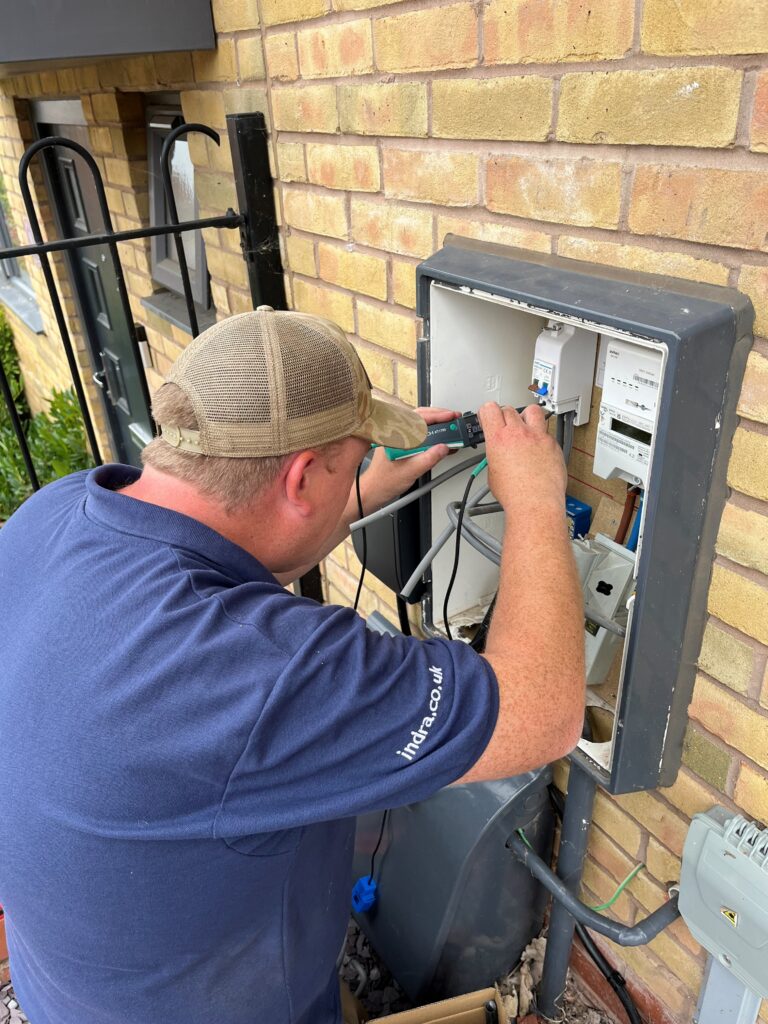
Installers: Here’s why 6mm² cable is the smart choice for installing EV chargers
In this article, Phill Brookes-Maddicks, a qualified electrician at Indra, draws on his hands-on experience to explain why it's best practice to using 6mm2 cable to install an Indra charger.
In this blog, we break down why Indra recommends 6mm² cable and a 40A breaker when installing Indra’s 7.4 kW EV chargers, and how this best-practice approach reduces callouts, protects your reputation, and delivers more reliable installs for your customers.
As an installer, you know that the correct cabling and breaker sizing is critical for safety, reliability, and regulatory compliance. At Indra, we recommend using 6mm2 cable, a 40A breaker and appropriate conductor classes (Class 2 and Class 6/7) for our 7.4kW (32A) EV home chargers.
While choosing the right cable diameter is essential for voltage drop and thermal performance, the type of conductor inside the cable—its class—is also key to ease of install and long-term reliability.
At a glance: why 6mm² and 40A matter
Before we dive into the details, here’s a quick overview of why our 6mm²/40A recommendation matters—and how it benefits you and your customers:
Lower voltage drop
Better thermal performance and current-carrying capacity
Compliance and reduced liability
Built-in futureproofing
Using the right cable for installation is key
Why we recommend 6mm2 cable and 40A breakers
1. Lower voltage drop
Lower voltage drop means the EV receives its full charging power and keeps the cable running cooler. Because EV home chargers often require long cable runs from the consumer unit to the driveway or garage, using 6mm² cable helps keep voltage drop within the 4% tolerance stated in the EV Charging Equipment Installation Code of Practice Edition 5, Section 5.3.5.3. It also helps keep the voltage at the charger within DNO tolerances (+10% / –6%), reducing the risk of nuisance O_PEN fault tripping events. Many installers aim to stay well below the commonly used 3% voltage drop target for final circuits.
Indra recommends using a 40A breaker with the 6mm2 cabling
2. Thermal robustness and current-carrying capacity
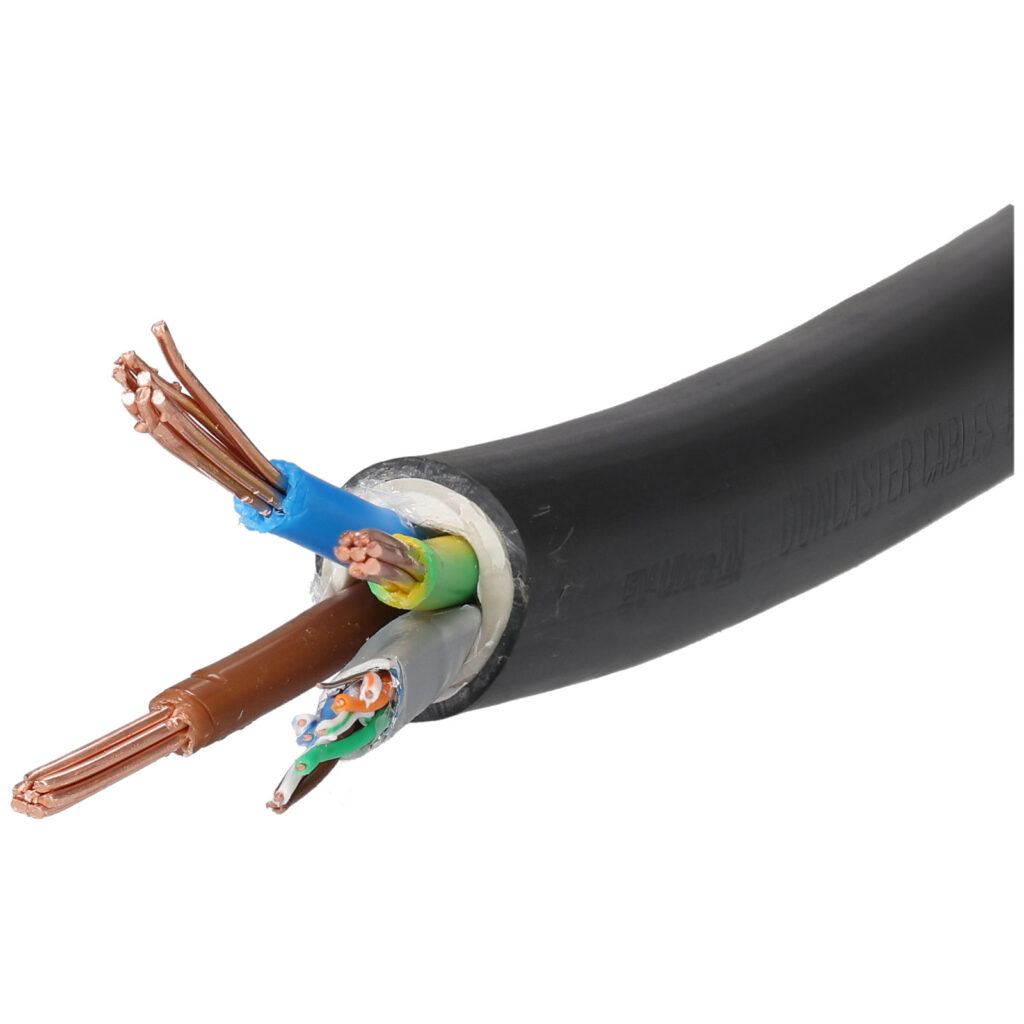
EV chargers run at a high, continuous load for long periods, which puts sustained thermal stress on the circuit. Using 6mm² cable reduces thermal build up in the switchgear, reducing the risk of nuisance tripping. Using a Class 2 or Class 6/7, 6mm2 cable has the added benefit of reducing physical stress on the electrical connections due to thermal expansion, compared to Class 1.
A 40A breaker is recommended because running a 32A circuit breaker for prolonged periods at its maximum rating can cause it to thermally trip.
3. Compliance and liability
UK wiring regulations (BS 7671:2018) do not mandate a specific cable size for 32A EV circuits, but it does require the installation to be designed considering:
Using 6mm2 helps satisfy these factors under almost all real-world installation conditions, reducing risk and liability for the installer.
An often-overlooked regulation that has considerable influence on the selection of cable type and size is Regulation 512.1.5 (compatibility) of BS7671:2018 Amendment 2. In short, it says that you must assume the maximum operating temperature of switchgear is 70⁰C unless the switchgear manufacturer states otherwise. Meaning that you cannot take advantage of the increased current-carrying capacity of a 90⁰C cable because the switchgear is only rated to 70⁰C.
This means that the maximum current rating of cables must be taken from tables 4D1-4D5, and no 4mm cable on these tables is rated at 40A or above.
4. Futureproofing
Installing 6mm² cable and 40A breaker first time allows for:
upgrading to a faster charger
load balancing systems
bidirectional charging (V2H/V2G)
without needing a costly rewire in the future.
It will also position installers as a forward-thinking professional who delivers long-term value to customers.
Even if the customer keeps a 7.4 kW charger, future features may benefit from the additional headroom.
Getting the right cabling and breaker on first install futureproofs the charger for the customer
When 4mm2 is still OK
The only conditions under which 4mm² cable can be used are:
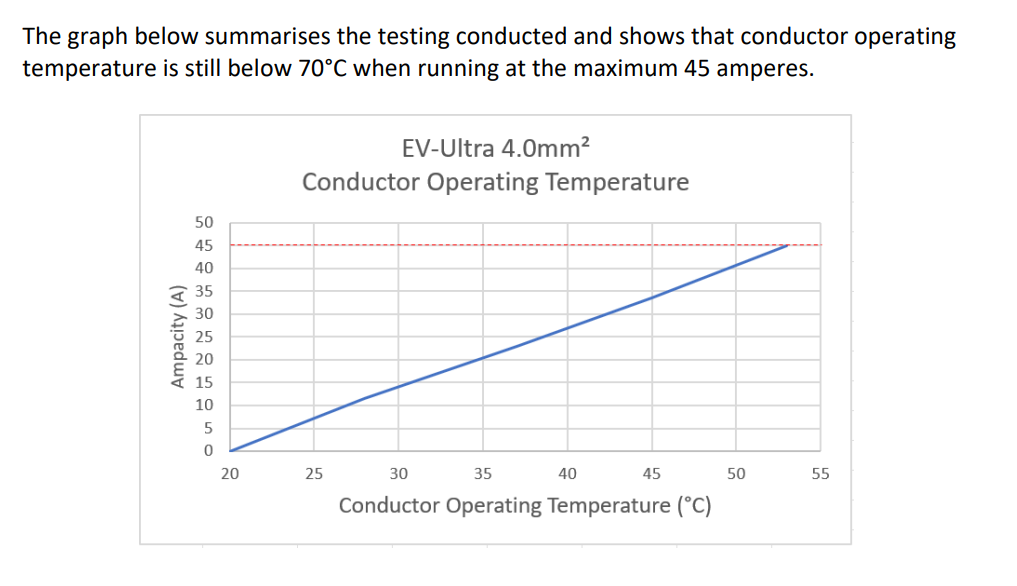
It is Doncaster EV Ultra® 4mm² cable, which has independent testing showing it can safely carry 45A continuously. (However, this deviation from BS7671 would need to be identified on the installation certificate) OR
The breaker is reduced to 32A, limiting the charger’s maximum current to ~30A
Because Indra recommends a 40A breaker, 4mm² cable is generally not suitable.
At present, Doncaster EV Ultra® is the only cable with verified data demonstrating it meets our thermal and current-carrying requirements (operating below 55°C at 45A continuously. For more information, refer to the EV-Ultra® Indra Technical Annex at the end of the article.
We are not endorsing the brand—it is cited purely as the current example that satisfies our standards.
Following best practice guidelines can prevent callouts and increase customer satisfaction
Installer benefits of following best practice
Using Indra’s best practice recommendations in this matter offers installers several benefits:
If attending an already installed EV home charger, where 4mm2 cable has been used inappropriately, we recommend that the original installer be contacted to discuss corrective action.
Using Indra’s recommended cable sizing also protects installers, as any future warranty investigation will assess whether the installation met our best practice guidelines.
At a glance: optimal installation
- 6mm2 cable (Class 2) - 40A breaker - ≤4% voltage drop target of EVs
EV-Ultra® Indra Technical Annex
Electrical Properties of EV-Ultra® 3x4.0mm² based on an ambient temperature of 30°C and conductor operating temperature of 70°C are detailed below.
Maximum current carrying capacity = 45 amperes (single phase)
Voltage drop = 12 mV/A/m
If the cable cannot be changed, reducing the breaker to 32A is possible. However, this should come with a drop in maximum charging current to ~30A, or the breaker may trip due to continuous near-limit current, resulting in repeated callouts.
When using 4 mm², installers must still verify that the appropriate cable calculations are within allowable limits.
About the author: Phill joined Indra in March 2022 as an Installer and Trainer after working for the Royal Air Force as an Avionics Technician for 12 years, and training as an electrician post-RAF. He is now the Sustaining Team Lead in Training and Installation.
Share this
Related articles
Indra adds EDF Smart Charging to its market-leading tariff line-up