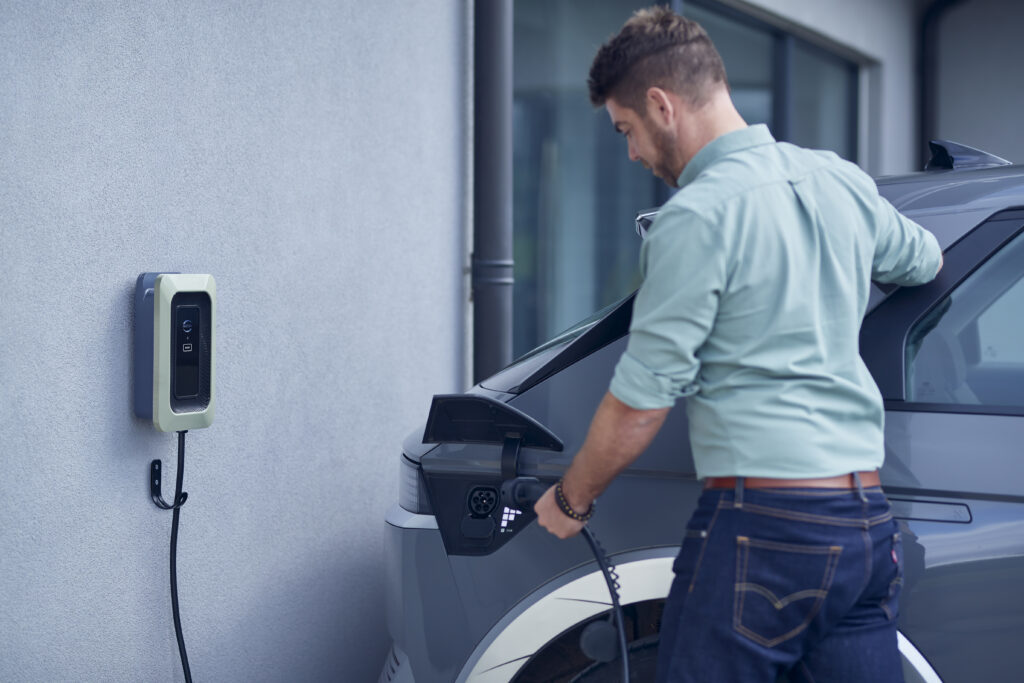
There are approximately 1.6 million fully electric vehicles (EVs) in the UK, approximately 4.75% of the total number of cars on the road, and growing numbers every month.
Although some may be hybrid, with a toe in the EV waters, there are still around 97% of drivers who are complete newbies to the concept of electric driving and charging and how to best charge is the first and most important challenge to get your head around.
This article will aim to demystify the whole area of electric car ownership, driving, and charging, so that those sitting on the fence about whether to take the plunge can be better informed of what it will entail.
In a nutshell, it’s basically the same as charging up your mobile phone, but for your car. EVs run on electricity stored in a battery, rather than by burning fuel (petrol or diesel) like a traditional car. As it’s not actually burning a fuel, there are no emissions from an EV, making it very environmentally friendly.
The amount of time it takes to charge and how much it costs depends on where and how you charge, but done right, it can save you a lot of money in the long term. The benefits of using an EV are:
So, let’s get into the details about the charging process.
There are three main types of EV charging in the UK. Put simply:
This is where the car’s charger is plugged into a standard 3-pin wall socket. This adds about 8-10 miles of range per hour and can take an EV about 24 hours, or more, to fully charge. It’s good for emergencies or very low daily mileage. However, this is potentially a dangerous option as the drawing of energy needed can create heat that can destroy the plugs and even cause fires.
The limitation of electrical charge needed to keep it safe makes the actual time taken to add charge very slow. We will explore the pros and cons of this option in another blog post shortly.
This is the most commonly used form of EV charging and typically involves a home EV charger or charging stations in public car parks. A level 2 charger will add 20-30 miles of charge for 7kW in an hour or up to 90 miles in an hour of charging at 22kW – depending on the make and model of your car.
A 7kW home charger uses 1-phase electricity, as this is the current in most UK homes, which will charge your car from 20-80% in approximately 6-8 hours, depending on the size of the battery and speed of the charger.
A 22kW charger needs a 3-phase electric supply, which is why they’re more commonly found in car parks rather than at UK homes. These options are best for overnight charging or topping up while shopping. Indra’s smart chargers operate at 7.4kW, the maximum power that most UK homes can cope with, and when paired with a smart EV tariff, can keep you up and running at some of the lowest prices.
This option is usually only available at public, high-traffic locations such as highways, shopping centres, commercial areas or motorway services, and is great for long trips and quick top-ups, as it can add up to 150+ miles of charge in about half an hour.
Some ultra-rapid chargers (100-350kW) are now available, but these faster charging options are generally much more expensive. There has, in the past, been a concern that rapid chargers can present a risk to battery health over time. However, studies show the impact is negligible in modern EVs thanks to built-in safeguards and using Level 2 charging, especially in warmer climates.
The latest to emerge in the industry is megawatt-level charging. Originally designed for heavy-duty transport, such as lorries, buses and long-haul trucks, it is beginning to be extended as a viable charging option for cars.
Some Chinese automakers, such as BYD, have already launched megawatt charging options for their EVs.
Able to deliver up to 3.75 MW of power with thicker cabling, liquid cooling and connectors to safely handle the higher currents. For comparison, a home charger typically delivers 7kW of power, but a megawatt charger is over 100 times more powerful.
This is the roadmap to helping reduce the reliance on diesel in commercial transport and enabling cleaner supply chains, enabling the UK and Europe to transition to zero-emission logistics. Currently, it is only available for long-haul trucks and heavy-duty transport. When the technology is in place, it follows that it will become increasingly available to cars.
Public charging can frequently be found at supermarkets, retail parks, on-street locations and motorway services, and will vary vastly in cost. Apps such as Zap-Map, PlugShare, ChargePoint, PlugSurfing, The Charge Scheme, Pod Point, and more can help you find a charger close to your location and explain how to access them. Home charging is the most convenient and cheapest option. A wall box charger (typically 7kW) is attached to the property on the driveway, front of the house, garage or other suitable location, and the EV can charge overnight at cheaper rates, especially if it’s a smart EV charger, such as the range at Indra. If off-street parking is an issue, there are alternative solutions, such as getting a pavement gully fitted to allow charging on the street from companies such as Kerbo Charge, Charge Gully and Gull-e. There are also some government grants available for helping with these installations.
Home charging is the most convenient and cheapest option, and depending on your energy tariff, it can be between 7p-26p per kWh*.
If you can benefit from cheaper, off-peak rates with a smart EV tariff, a full charge can cost as little as £4-£6 for a full battery. A home EV charger (typically 7kW) is attached to the property on the driveway, the front of the house, in a garage or other suitable location, and the EV can charge at cheaper rates, especially if it’s a smart EV charger, such as the range at Indra which can integrate with the smart EV tariffs from OVO and Octopus. Generally speaking, home charging is between two and four times cheaper than petrol.
If off-street parking is an issue, there are alternative solutions, such as getting a pavement gully fitted to allow charging on the street from companies such as Kerbo Charge, Charge Gully and Gul-e.
Alternative technologies for charging near the home include lamppost charging and on-street hubs. There are also some government grants available for helping with these installations.
See our price comparison of the average costs for public charging and home charging below:
| Charging Context | Average Cost (pence per kWh) * |
| Public charging – Slow/Fast (PAYG) | 52 p/kWh |
| Public charging – Rapid/Ultra-rapid (PAYG) | 76-79 p/kWh |
| Home charging – Standard tariff | capped around 26 p/kWh |
| Home charging – Smart/Economy-7 tariff | ~7 p/kWh |
*Prices as of July 2025 – sources Zapmap and Whatcar.com
EV charging plugs are the physical connector that links your EV to a charging point to allow the electricity to charge up the car’s battery. The different plugs will depend on the charging speed and the region or standard used in the country. The main types of EV charging plugs in the UK are:
Both the Type 1 and CHAdeMo chargers are becoming increasingly obsolete, and modern EV models mostly operate with a Type 2 or CCS charging plug system.

Choosing the best way to keep your EV up and running will depend on your lifestyle, driving habits and budget.
For most drivers, home charging with a dedicated charger connected to a smart EV or off-peak tariff is the cheapest and most convenient solution. This allows you to plug in overnight and wake up to a fully charged battery at minimal cost.
However, if your car needs to take you further afield for work or leisure purposes, then public charging is a useful top-up option and longer journeys can be accommodated with rapid chargers at motorway services to give you hundreds of miles of range in under half an hour.
The key is to mix and match, rely on home charging for everyday use, and use public networks for flexibility and long trips. With the ever-expanding charging infrastructure across the UK, powering your EV is becoming easier and smarter every day.
See the Indra smart EV range for a slim, sleek, modern, high-quality charger compatible with smart EV tariffs.
 | About the author: Sonya joined Indra in July 2025 as Senior Content and Marketing Executive. She is a content writer with several years of experience who is now using her expertise to help Indra communicate their branding, products, and the benefits of EV driving for both individuals, society and the planet. |